Monday, March 1, 2010

THE PITFALLS OF ASIAN AMERICAN INDIE FILM (REMIXED)


Since late last fall, Joel Quizon, myself and a couple of others have been serving on the feature film screening committee for the upcoming Los Angeles Asian American Film Festival. Both of us our veterans of these screening teams - this is my first year working with Visual Communications but I put in my time with NAATA/CAAM up north while Joel's been a stalwart for VC a few years going too.

I can only assume Joel drew upon this experience when he laid out his "How To Avoid the Pitfalls of Asian American Indie Movies" guide recently. These were so good I wanted to expand on a few of them based on my own experience (read: gripes).
    JQ: 1. Try to avoid the following words in your title: Jade, Yellow, Dragon, Red, “Scent” of anything or anywhere “Home”, Jasmine, Rice, Masala, (or really anything related to Asian cuisine like Dim Sum, Sushi or Adobo)

    OW: It is incredible how many films get submitted with pseudo-Orientalist variations on the phenom he outlines above. Besides being self-exotifying, it's a very clear message to people that, "this film should not be taken seriously." Of course, if your name is Mira Nair, you can probably get away with this sort of thing but otherwise, if your movie title sounds like something found on a Chinese take-out menu, you need to brainstorm a little harder.

    JQ: 2. When depicting family life, try your best to refrain from depicting parents as domineering, traditional, heavy accented, always in the kitchen, playing mahjong, gardening, doing Tai Chi, or gossiping.

    OW: I understand that family melodramas - especially those involving the generation gap - are a fundamental part of Asian America's cinematic ouvre. And sure, there are some very good executions on this theme in both narrative and documentary forms. However, too frequently, the older generation is reduced into a cheap caricature in order to introduce an antagonist, and thus, some level of dramatic tension into a narrative.

    A good story needs tension. It needs antagonists (whether people or situations). But you can't be lazy about it. The only villains who can be easily fashioned out of boilerplate are Nazis and these days, even Nazis have nuance. Otherwise, if you're going to create conflict, at least try to create an actual, human-like foil rather using Asian parents as shorthand for "soul crushing authority figure."

    Here's the thing: everyone has issues with the parents and this lulls filmmakers into assuming that they can get away with said shorthand. But most people also tend to love/like their parents, despite those issues. We understand that our parents and their generation are complicated and went through all kinds of sh-- that we'll never have to. That doesn't make them saints. But it does mean that they deserve better. It's bad enough when mainstream Hollywood subjects Asians to flat stereotypical depictions yet I am astounded how many Asian American filmmakers turn around and do the same thing to their parents' generation because they lack the imagination or skills to render better characters.

    JQ: 3. When casting a boyfriend for the female character, think twice about casting a white guy (no offence at all really and you may very well want to reflect how society has finally embraced interracial couples). At the very least, consider occasionally depicting Asian men as the virile, non-emasculated beings that they are. Your dad will thank you.

    OW: I don't want to get deeper into this can o' worms except to say that, too often, interracial relationships are the second most common attempt at introducing narrative tension/conflict (behind a--hole parents) and this cliché is just as transparent too. Step your writing game up.

    JQ: 4. When choosing an occupation or course study for the main character, try vocations other than: writer, filmmaker, actor, or martial arts instructor.

    OW: Another indication of a severe lack of imagination. Again, step your writing game up.

    JQ: 5. For the main character, opt for injecting well written dialogue instead of distant, silent posturing. Communicative characters communicate a lot to the audience.

    OW: Joel nails this one. My feeling is that filmmakers assume that sullen-ness will be equated with depth...as if keeping your characters silent is meant to actually communicate the ocean of conflict and turmoil flowing beneath the surface.

    Or maybe you can't write dialogue.

    Either way, there is nothing less interesting to watch than a character who just sits on the screen, looking pissed off and explaining not a single idea, thought or feeling. There's no momentum to be squeezed out of a scene like that, let alone something visually compelling.

    JQ: 6. For the film score, please avoid using a koto, a gong, a mouth harp and your friend who can play guitar but can only play nondescript noodling.

    OW: I can't even try to be polite here.

    F--- droning, "moody" guitar scores. Nothing screams "cliché indie" faster than hearing yet another score based entirely around some depressed emo guitarist pluck out 80 minutes of rhythm-deprived, melody-challenged "music." There's a ton of free, creative commons musical scores out there: sharpen your google skills.

    I had nothing to add to these:

    JQ: 7. I know you have an Aunt who has a nice big pad down in Diamond Bar or Oceanside, but when choosing a location, try a little variety. Also avoid your friend’s restaurant and when shooting a scene that calls for some serious introspection try NOT using a rooftop (This goes for romantic dinner scenes too. As we all know it is far too cold and windy up on roof tops to be having a candle lit dinner and having a mariachi band there gets

    8. When making a documentary film, it is not always necessary to have the filmmaker on camera. Unless you are Michael Moore or Morgan Spurlock, it can be a hindrance especially when making a film about lepers from Malaysia, unless you yourself is a leper from Malaysia, then that would be fine.

    9. If you think making a documentary about going back to the motherland and hanging out with your family and rediscovering your roots sounds like a great idea…it’s not. Not anymore at least. Not unless you have an entirely different spin on it, like you’re Lou Diamond Phillips or a leper originally from Malaysia.


    OW: Amen.

    JQ: 10. Finally, watch lots of movies. Good movies. See early Wayne Wang and Gregg Araki films. Analyze Better Luck Tomorrow with as much fervor as you would Reservoir Dogs. Watch the first films of Spike Lee, John Singleton, Jim Jarmusch, Gus Van Sant and Allison Anders. Watch John Ford’s Stagecoach and Chang-dong Lee’s Oasis over and over again. Binge on 70’s American cinema and films of Japanese masters. Seek out films from by Lino Brocka, Pen-ek Ratanaruang or Hirokazu Koreeda. Go to film festivals even though your film is not in it. But don’t get overwhelmed by these films because you can make something good too.

    OW: Wait, John Singleton? Has he even made one unqualifiably good film? Has anyone watched Boyz N the Hood lately? I bet it won't seem as good as once it may.

    In all seriousness, I don't know if the fundamental issue is that not enough filmmakers aren't watching enough movies. I think it's that they've absorbed all the lessons on the technical/visual side of filmmaking but haven't matured sufficiently as writers and storytellers. Every year on these screening committees, I am astounded at how many technically competent films are made that have absolutely no sense of character or narrative development. That's filmmaking 101 (or at least, should be). Sure, a lot of big budget directors can't tell a story worth sh-- either (hello Michael Bay!) but at least they have a few hundred million dollars worth of FX to distract you from that shortcoming. Your $10,000 indie film only has your script and hopefully some decent acting going for it.

    (As others have noted, most of this isn't unique to Asian American filmmaking; it's a problem with indie filmmaking at large. But that doesn't mean "our" community can't make use of these ideas).

Labels: commentary

--O.W.

<< Home

Wednesday, September 2, 2009

A RESPONSE TO "HOLLYWOOD AND ASIANS: WHY PROTESTS ALONE WON'T CHANGE ANYTHING"


Angry Asian Man reported on a post by Philip Chung as to why protesting against anti-Asian scenes or characters in Hollywood films won't make a difference without market clout. To quote, "until Asian Americans as a whole are willing to put down our money to support the work of our Asian American filmmakers—nothing will change. We can protest all we want, but real change will not happen until Hollywood knows we are an economic force that can make a difference in their bottom line."

He goes into some detail in his analysis, including comparisons between the African American, Latino American and Asian American filmgoing audiences. He also acknowledges that part of the problem with Asian Americans supporting Asian American film is because:
    "a lot of Asian American films suck. And I agree with that. It’s hard to muster enthusiasm and support when you keep getting bombarded with these emails about how you have to support such and such film to show Hollywood that we have box office clout and you go to the theater and wind up watching one crappy movie after another."[1]

The one point I was waiting to hear Philip make - what, in my opinion, is the fundamental point - never came, much to my surprise. That is: the main reason why "Asian Americans as a whole" don't support Asian American film is because "Asian Americans as a whole" do not exist.

What I'm saying here should not come as some big revelation; the basics of the idea have been around for decades and the logic is rather intuitive.[2]

Asian Americans are a diverse conglomeration of very different ethnic groups - each with their own linguistic, cultural, religious, and political histories/traditions. Especially since Asian America is still a majority foreign-born population and overwhelmingly a 1st and 2nd generation immigrant community, our differences are far more numerous than our similarities.

The term "Asian American" is useful as a political identity and as a symbol of solidarity (or desire for such). It's a convenient fiction but one that also comes with some inconvenient truths, not the least of which is that it is unreasonable to expect that such a diverse community is going to unite around common causes, least of all cultural products.

In this regard, you really can't compare Asian Americans to African Americans who have an entirely different history, culturally and politically, that has contributed to their consumer clout. You can't compare Asian Americans to Latino Americans - the latter may also be pan-ethnic but there's no equivalent of Spanish language and Catholicism in the greater Asian American community to act as points of commonality. We also lack the demographic clout of both other groups given their larger population numbers.

Most importantly: there are still rampant examples of anti-Black and anti-Latino imagery in Hollywood. However viable "Black Hollywood" may be that has not suddenly made mainstream Hollywood politically enlightened when it comes to how Black men and women are portrayed. What is different - at best - are the shades of racism. You probably would not have seen a comedic scene where a White man is beating up a Black man, yelling "Kunta Kinte." But that doesn't mean there aren't more subtle forms of anti-Black racism being played for laughs elsewhere; it's just less unbelievably blatant than what we saw with The Goods. (The Angry Black Woman blog makes this same basic point too).

That's certainly a reflection of the different kind of political power African Americans can wield in this respect relative to Asian Americans. It also reflects the consumer demographic clout being spoken about too. But my point is that even with that, it doesn't prevent/insulate. These images have currency that exceed the level of political or economic will that could be brought to bear to prevent/attack them. Let that sober you up for a moment.

***


On another point: the lack of Asian American support for Asian American cinema is problematic for reasons that don't need to be rehashed but I think it's misdirected to argue that "we're not doing enough to support" without first trying to tackle this question: what is "our" motivation to support?

Why would Korean Americans care if a new film, directed by a Vietnamese American filmmaker, comes out? Will anyone besides Taiwanese Americans (and Dawson's Creek fans) flock to go see Formosa Betrayed?[3] And what about South Asian American cinema - a far far bigger genre than most (who are not South Asian) are even aware about? I never see people urging me to go see the latest Indian American comedy but I do get those emails when it's an East Asian American director. What does that say about "us"?

This is not even about political allegiances, it's about asking a more basic question that's been kicked around for years (and no one can answer for good reason): what kind of Asian American stories are going to have mass appeal across the AA spectrum? I can't imagine what the equivalent to an Asian American Tyler Perry would be since his films, whether you like them or not, could be said to be tapping into a critical mass of desire for certain images and characters that is big enough to be commercial viable. I don't know what the Asian American equivalent would be since it'd have to be pan-ethnic and pan-generational.

That's why I respectfully disagree with Philip's assertion that, "Nothing will change, if our community won’t step up and show Hollywood the green." There is no "community" that is meaningful here, at least not in the way Philip is trying to speak to. Suggesting that we aren't doing enough to support "our own" films makes large assumptions regarding the nature of a collective AA identity and community.

In essence, I'm questioning the underlying logic as to "why AAs don't go see AA films." It's not because of the quality of those films (though poorly made AA films don't help the cause). It's not because producers aren't doing enough to market. It's not because audiences are cheap/lazy/ignorant bastards. It's because there's no such thing as an "Asian American film" that could possibly speak to more than a fraction of AAs.

The best you could ask for, at least for the time being, is a film that happens to include Asian American filmmakers and/or actors but whose themes are more - and I seriously hate this word, but it gets batted around enough - "universal." The problem here, for me, is that "universal" is shorthand for "White" or, at best, "a Will Smith film." So to make a "successful" Asian American film in terms of box office would likely mean making a film that isn't actually distinguishable as "Asian American" except by its casting or staffing. Once you get to that point, you're walking a fine line where Asian American involvement can go from "incidental" to "irrelevant" and thus, "disposable" which puts us back at square one.

This is all getting off-tpic though; I think if things are going to change in terms of our images in mass media and Hollywood in particular, it will have to happen through other means than pushing for AA to unite as a consumer bloc.

***


First of all, there is one group that is far smaller than Asian Americans yet wields tremendous influence in Hollywood - Jewish Americans. Is there still anti-Semitism in Hollywood? Absolutely. But in terms of shades of difference, the kind of anti-Semitism that does exist is far more coded, on average, than the blatant forms of anti-Asian racism you see. That's for at least two reasons: 1) Jewish American political organizing has given them a great deal of clout to make their protests heard faster and taken more seriously than those of other groups. 2) As some of you may have heard, there's, uh, a lot of Jews in Hollywood, at every level in the industry. There's many reasons for this, not the least of which is that the entertainment industry was an avenue open to Jewish immigrants and their children at a time where anti-Semitism kept them out of other, traditional routes to upward mobility. That aside, what you have is a vertical integration of Jewish Americans in Hollywood from writers up to directors up to studio heads. A really terrible, anti-Jewish joke is going to have to make it past, in most cases, a lot of Jewish American eyes - and signatures - to get green-lit into production.

Asian Americans have made great strides to become better represented in Hollywood but we're just not at the same level and I think the fact that we're also not as well politically organized (for all the same reasons I laid out above), also limits the influence of individual AAs placed in the Hollywood structure.

This speaks to my second point: I think many people in Hollywood understand, on some basic level, you don't try to play up anti-Semitism for laughs (unless you happen to also be Jewish...see Sasha Baron Cohen in Borat for example) unless you really feel like having your bosses, JDL and Jewish American politicians come after your ass. (Despite this, you can still find plenty of examples of anti-Semitism in Hollywood...which goes back to my earlier point that these images have currency no matter what kind of influence you can hope to wield elsewhere).

I don't think there is a similar culture of avoiding anti-Asian humor in Hollywood. I think Asians are still easy, fair game by writers who have not gotten it into their head that, "this will get me into trouble." THAT is the real change that would need to happen - a shift in the culture of those working in the industry to stop and contemplate possible repercussions. Would an Asian American consumer bloc help with that? Absolutely. But so would greater involvement by Asian Americans in the industry itself. And so would greater Asian American political clout as we have seen through grass roots movements to protest those images we find offensive.

Philip's post was trying to say, "protests aren't enough," and while I agree with him to a certain extent, I feel like his post is throwing the baby out with the bathwater. If NOT for protests, then you have very little public awareness. And the less public awareness you have, the less likely it will be that you will affect change within the minds of writers, directors, studio heads, etc. who generate or green light bad characters and scenes to begin with.

Yes, we can speak with our green but that shouldn't minimize how effective, in many ways, public protests have been in changing the culture of Hollywood. It may be that folks are slow to listen but that alone isn't reason to stop hollerin'.

***


Notes:

[1] The irony is that in the comments section, someone was urging people to go out and support a new AA film which personally, I thought was terrible when I screened it for the SFIAAFF. Given that the film hasn't actually come out for release, I thought it was unfair to put it on blast but I just feel depressed that there's such a push to get people to see it. Then again, if it comes out and makes gobs of money, even if I think it's a bad film, it still could be said to be doing some good.

[2] It would be apropos to mention the two main texts dealing with these issues: Yen Le Espiritu's work on Asian American panethnicity or Lisa Lowe's seminal essay, "Heterogeneity, Hybridity and Multiplicity."

[3] Based on the previews of that film, I'm really tempted to call it Taipei-ssippi Burning but again, it's probably best to suspend judgement until it comes out.


Labels: commentary

--O.W.

<< Home

Tuesday, May 6, 2008

FRESH FROM VC


For the first time, ever, I've attended the annual Visual Communications Film Festival in L.A., the largest Asian American film fest of its kind in Southern California. This year, I wasn't able to attend the SFIAAFF for the first time in over 10 years so I'm glad I finally made arrangements (read: find a babysitter) to at least get out to part of the VC fest (alas, I won't be able to see more than 2-3 films this year).

I went to go see Santa Mesa, by New Jersey filmmaker Ron Morales. (Interestingly, if IMDB is correct, Morales has a long background in working on films as a crew member but this is his first directorial work). In general, I resist saying too much negative about any film that is still seeking distribution so I'll keep this brief:

I found Santa Mesa to be beautifully shot by Yaron Orbach and the setting - a fascinating slum built around a rail station outside of Manila - was incredible. However, the strengths of the production values weren't equally matched by the storytelling. In terms of basic narrative, character development and script, the dynamics rarely cohered even though you could see what the filmmakers were trying for. I'll leave it at that - if the film gets distribution, I'll expound at that point.

Two separate thoughts:

1) In the last 5-7 years, I've seen a real leap forward in the production/technical values of Asian American cinema. I surmise this is the product of both 1) a generation of API filmmakers who've gotten more professional training, a very hopeful sign for the future, and 2) improvements in technology - both in terms of access and capability - that is empowering younger filmmakers to make better looking/sounding films without the exorbitant cost that might have been the case a generation ago.

However, what has yet to develop as quickly has been storytelling skills. The latter, I think, is far more difficult to master and, to be sure, it's hardly an API-specific challenge (just look at mainstream cinema). What I find interesting is how the ideas have gotten much more ambitious - Santa Mesa, for example, tries to do a lot with its characters and their relationships in ways that I don't think you would have seen 10 years ago. But ambition aside, execution is still uneven, especially in scripts. Like I said, I don't think that's unique to API filmmaking but it has been a historical challenge that, in my opinion, has yet to be transcended en masse.

2) I'm really intrigued by what seems to be a small wave of Filipino American directors going to the Philippines to make their movies. Apart from Santa Mesa, the excellent Cavite comes to mind and I know filmmakers like Romeo Candido and Gene Cajayon are actively working in the P.I. too. I know part of it is practical - the cost of filmmaking is much more affordable out there compared to in the States but obviously, there's a kind of transnational storytelling that's part of it too. I'm very intrigued to see how this will play out over time and how Filipino American stories will develop in that midst. Will we see more international storylines, such as in Santa Mesa?

Labels: commentary, film festivals

--O.W.

<< Home

Sunday, March 16, 2008

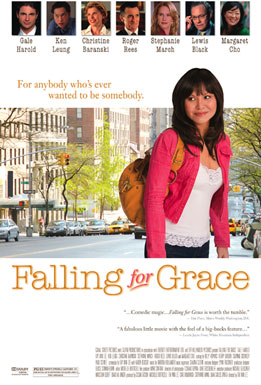
FALLING FROM GRACE


needing more than luck?


Even though I've enjoyed this weekend, hanging out with my daughter while my wife takes a much needed/earned vacation, I'm a little sad I'm not up in San Francisco for this year's Asian American film festival. This is the first time in 11 years that I won't be attending and it is, by far, one of my all-time favorite events.

That said, part of me is glad I'm not there because I feel out of the Asian American film loop at the moment and I think being at the fest would just remind me of how disconnected I am right now. It's not for lack of interest but lack of time. I certainly want to get back into the mix, not the least of which is so I can update this site.

In terms of a late pass, I recently became aware of the mini-controversy over Fay Ann Lee's new feature film, Falling For Grace, a romantic comedy/Cinderella story (you can see the trailer at the link before). I say "mini" because, though the internet has a tendency to inflate things beyond their actual size, this film has mapped onto so few people's radar, I don't think you can really call it a major dust-up.

The main sides are represented by the Fighting 44s on one side and Reappropriate's Jenn Fang on the other. The main crux of it turns around (drum roll): Asian female/White male interracial romance. Call it Asian American gender relations catnip.


CONTINUE READING...

In Falling For Grace, Grace Yang, an upwardly mobile Chinese American investment banker[1] is mistaken (by White people, natch) for the scion of the Shanghai Tang family, ends up meeting a very eligible (White) bachelor (modeled on JFK, Jr. no less) and hilarity and romance ensue. Presumably.

The Fighting 44s, self-appointed defenders of Asian American masculinity, not surprisingly, crap all over the film on premise alone: "More brainwashing material for Asian girls to chew on."

Their stance doesn't surprise me since it springs from the the same kind of reactionary, masculine politics that certain Asian American men have carried as cross, shield and sword since the 1960s. I'm sympathetic to parts of it - namely the critique of how absent Asian men are in popular American media - but the ways in which it's oft-used to bludgeon Asian American women (and curiously, feminists) seems self-defeating at best and retro-grade patriarchal at worst.

I'm more surprised at Fang's decision to support the film despite the fact that she - like mostly everyone - hadn't actually seen the film yet[2]. I usually find her analyses to be nano-blade sharp, with plenty of nuance and insight to go around, but here, she stakes her defense on a curious argument:
    " it occurs to me that if we are to begin challenging the perception that Asian Americans consume like Whites (thus undermining efforts to create Asian American-oriented media), we need to demonstrate a willingness to support Asian American-created art and film. So, I hope that regardless of how you feel about the AF/WM coupling in this film, you will take the time to see this movie (and give it a chance to speak for itself), and thus help support the overall cause of funding more Asian American-produced independent media."
This too is based on a very old set of politics, one that I find similarly outdated and though nowhere near as noxious as the belief that a portrayal of interracial romance is an automatic sign of "selling out," I'm no less exasperated with the implied ethnic/racial obligation that comes with it.

This is something I discussed, along with my friend and colleague Hua Hsu, back in 2003 when Better Luck Tomorrow came out and there was that massive grassroots push to get Asian Americans out to see the film. But BLT was hardly the first or last film to make this pitch and I've always been skeptical of the underlying logic.

In essence, it seems to suggest that whether the film is good or bad, people should see it as a way to empower the director and producers and presumably, if this takes off like My Big Fat Greek Wedding, it will be one more step in the empowerment of Asian Americans to take control of our own media images. Distill it down from there and what you basically get is, "support it because it's Asian American" and that seems like a remarkably reductive logic - no less so than arguing that one should support Obama simply because he's Black and thus, might help reform failing federal civil rights legislation[3].

But shelf the ideological problems for moment and consider a few pragmatic ones:

Demographically, Asian Americans rarely have wielded the kind of clout to - alone - make any film project "successful." That's why - as Justin Lin has said in many interviews - Hollywood studios rarely even bother to break AAs down into a separate viewer bloc; we're usually lumped in with Whites. The most successful Asian American films of the last 26 years - from Chan Is Missing to Joy Luck Club to Better Luck Tomorrow - have always depended on the patronage of non-Asian viewers in order to ensure that success. I'm not claiming AA viewers make no difference at all; by filling seats, we're adding to the overall box office totals, but it's hardly the case that, as a demographic bloc, our support is really the one that matters most[4]. The mainstream success of practically any Asian American film I can think of depends on attracting a large number of non-AA viewers.

Second, even in the case where you have a "success," the fruits it bears are questionable. Wayne Wang's early career is particularly instructive here. With the exception of the uniformly brilliant Chan Is Missing, Wang's next three American[5] films were all family melodramas: Dim Sum, Eat a Bowl of Tea and of course, The Joy Luck Club. Wang's success - both critically and commercially - with those films, I would suggest, played an important role in how future Asian American features would get greenlit/funded[6]. I don't think it's a coincidence that throughout the remainder of the 1990s and well into this decade, most of more prominent Asian American features you saw follow were also family melodramas (at least in part, if not wholly), from Mina Shum's Double Happiness to Ang Lee's The Wedding Banquet to Chris Chan Lee's Yellow to Gene Cajayon's The Debut to Alice Wu's Saving Face. There are many, many more one could name and personally, if I never see one more Asian American family melodrama come down the pipeline, it will be too soon (but that's an essay for another time).

Third, if we look to other examples, it's not very auspicious. My Big Fat Greek Wedding earned over $100,000,000 - far more successful and profitable than any comparable Asian American feature but I haven't seen that translate into a sea-change in Greek American representations (not that I follow them that closely though) and while it's likely helped Nia Vardalos to get more of her scripts noticed, she's far from some Greco American Spielberg (or even Spike Lee).

Again, it goes back to the consumer demographic. Tyler Perry has become a major force as a director and writer because his films consistently make money off of a viewer base that actually wields clout: African Americans. Likewise, I don't think we're far away from seeing a new generation of Latino American filmmakers come up in a big way. But Greek Americans won't make or break a film, let alone fuel a community media movement. Asian Americans may be larger in numbers but certainly, it's a disjointed community and even with 100% support (which won't exist anyway), we're talking...5-7%? That's good enough for phone companies to call my house, confusing my JA wife by trying to sell her long distance service in Mandarin. But that's not going to attract much interest by Sonyfoxwaltwarnerviaelectric to see after our needs for diverse representation.

I do agree that as more Asian American filmmakers, producers and movie execs rise in stature and influence, this could have some positive benefits for the community though, once again, the past reveals some uneven results. Wang, for example, was able to parlay the success of Joy Luck Club into a healthy career for himself but notably, up until this year, with his two new films based on the short stories of Oakland's Yiyun Li, he stopped making films dealing with explicit "Asian American content" for nearly 15 years (J.Lo romantic comedy though? Check!) I don't begrudge Wang that - by the time he made Smoke, Wang had made four significant Asian American films already so and creatively, I could see why he'd want to move onto something different.

Better Luck Tomorrow gave Justin Lin's career an immeasurable push, allowing him to direct two Hollywood flicks and he was able to parlay that back into his recent Asian American comedic feature, Finishing the Game. And, as he has noted, it was only because he was helming the movie that allowed him to cast Sung Kang in FF3, giving the movie some added "color" and an interesting Asian American anti-hero. However, the film has been rightfully criticized for having fairly limited portrayals of Asian women. One step forward, one step back?

My point is that we certainly need more Asian Americans in positions of media power but the road to greater diversity in our representations is likely to be fraught with bumps and dips along the way. And so this brings me back to the crux of my long-winded polemic:

You need to first start with a "good" film. That's obviously subjective but what I sense in Fang's argument is that the film's formal merits - narrative, acting, production design, etc. - are secondary. She asks: "how will we get funding for quality storylines if we won't even demonstrate our interest in films with Asians in front of and behind-the-scenes?" One of the commenters of her blog adds: "Until Asians become part of the mainstream film making, we should not be so critical of their work."

This may be classic cart vs. horse but shouldn't the more important question first be: does the actor or filmmaker deserve our interest to begin with? I'm not talking about Falling For Grace or the people who worked on it - I just mean any film. I can't see how blind support - absent any sense of quality control, let alone critical evaluation - is a helpful, progressive strategy.

My sister-in-law, who is Asian American, is a working actress and as supportive as I am for her and her career, that doesn't mean I automatically would cosign on any project she does, independent of considering its content or qualities (as I would with any project). Case in point: she was Fook Mi in Austin Powers: Goldmember, ok? I admit, when that movie pops up on television, I have that moment of, "oh cool, it's Di!" when she first shows up but that's then followed by, "man, I know this is Austin Powers and what not but the Japanese schoolgirl twins feel kind of icky to me." If I'm not about to cut the godmother of my daughter that degree of blind slack, I'm sure as hell not about to rally the community around any film project without some level of evaluation (let alone one with a weak trailer and middling reviews)[7].

The last point I want to make here is that if you look at the increase in the quantity of Asian American feature filmmaking, it is remarkable. I was on the film festival committee for the S.F. Int'l Asian American Film Festival from 2000 through 2006 and just in that time alone, the number of AA feature films has increased exponentially - so much so that in any given year - especially now - the number of feature film submissions to the festival is staggering.

Let me be very blunt in saying this: the vast majority of those submitted films are flat-out terrible[8]. We're talking bad enough to invoke a mercy rule during evaluation screenings. Do these films have well-meaning - even likable - Asian Americans directing/producing/acting in them? Absolutely.

Does this mean they are deserving of our support? Absolutely, positively not.

And this is telling: if a community-based media organization - whose entire raison d'etre is to support independent Asian American filmmaking - decides to pass on dozens of these projects, why would we ever expect "the community," as a whole, to get behind them?[9]

To me, there are so many opportunities to support Asian American films that if one happens to take an L -whether because it deserves to and just happens to be unlucky - it's not as if there won't be another one following behind it in a few weeks/months time. Personally, I'm left dizzy trying to keep up with what Angry Asian Man reports on in terms of new films. True, many of them still need distribution and that's still the golden threshold to cross. But again, not every AA film deserves distribution, at least based on the idea that it being AA is some how "good enough."

Ten years ago, seeing any kind of AA film in theaters was remarkable. These days, even though it isn't quotidian, it's hardly unusual either.

In other words, there's a lot out there to see.

Choose wisely. [10]

Notes:
    [1] I'm surprised that with all the brouhaha around the film, there doesn't seem to be much of a class critique of a protagonist with upwardly mobile ambitions. Not having seen the film, maybe there's a reason for this. Perhaps Tang pulls of a Michael Clayton, brings down a corrupt firm, and then joins AIWA.

    [2] I should preface all this by noting I haven't seen the film, only the trailer. But if I can be blunt: based on the trailer, this looks simply terrible. I like romantic comedies and it's probably not fair to judge a film by its trailer but there is little I can see here that makes the film look remotely appealing. The whole set-up is ridiculously gimmicky, the acting doesn't seem particularly good and the "funny" scenes included are anything but. The racial romantic politics are completely irrelevant to my skepticism (though, to be sure, it's not a big selling point for me either). According to Fang: "The trailer doesn't really do the film justice at all." I can only hope she's right.

    [3] Given that Fang has quite eloquently explained why supporting Obama should go beyond simple identity politics, I'm all the more bewildered by her stance on the film.

    [4] If anyone can show me marketing analysis that says otherwise, I would genuinely like to see that research.

    [5] I'm excluding his obscure, Hong Kong feature, Life is Cheap...But Toilet Paper Is Expensive.

    [6] Just to undermine my own theory, the fact that most of these films I go on to mention required hustling up funding just to get a shoe string budget might suggest their popularity isn't because people are rushing to give money to make them.

    [7] The SF Chron reviewer panned the film except to say: "It is only when Grace is with her mother (Elizabeth Sung) and father (Clem Cheung) that "Falling for Grace" hints at what might have been. There is a genuine poignancy in these moments as the dutiful daughter tries to care for aging parents who are proud and stubborn. These scenes are terrific." See: the trope of the family melodrama strikes again!

    [8] The increase in submissions and general paucity in quality are related by the fact that technological access to filmmaking has created a massive wave of amateur filmmakers who have the ability to "make movies" in ways that previous generations did not. The problem is that, in most of these cases, the ease of acquiring the means to filmmaking has not been matched by a mastery in actual filmmaking education, let alone prowess.

    [9] I haven't been on the film festival committee since I moved out of the Bay Area in 2006 so I have no way of knowing if Falling For Grace was ever submitted to the SFIAAFF but the fact that it wasn't programmed either this year or last year suggests to me that it didn't make the grade. I have no hard evidence to support this so it's purely a conjecture. But I also know, in the past, the festival has routinely passed on "high profile" Asian American features because, frankly, the staff thought the movies were of poor quality, regardless of profile.

    [10] Of the Asian American films I have seen in the last year, I thought In Between Days was actually good. I thought Baby was overly derivative but still powerful in moments. Shanghai Kiss was great for Ken Leung fans, a poor movie otherwise. Both of Wayne Wang's new films are decent but uneven. Same could be said of Finishing the Game which had some flat-out hilarious moments but didn't go the distance while I found Undoing ambitious but ultimately lacking. Same could be said of Americanese (love Eric Byler, wasn't crazy about his adaptation). That's eight films I just rattled off. See my point?


Labels: commentary

--O.W.

<< Home

About Chasing Chan


Previous Posts

  • A QUICK FYI
  • REVIEW: AU REVOIR TAIPEI
  • REVIEW: DIRTY HANDS: THE ART AND CRIMES OF DAVID CHOE
  • RIP LONI DING
  • THE PITFALLS OF ASIAN AMERICAN INDIE FILM (REMIXED)
  • MY BAY AREA PEOPLES
  • AUSTIN'S AAFF COMING UP SOON!
  • HARIMAYA BRIDGE INTERVIEW
  • SAN DIEGO'S FILM FESTIVAL KICKS OFF THIS WEEK
  • INTERVIEW WITH SFIAAFF'S CHI-HUI YANG

Archives

    03.82 | 03.99 | 07.01 | 02.02 | 09.02 | 02.03 | 03.03 | 04.03 | 05.03 | 10.03 | 03.04 | 07.04 | 03.07 | 07.07 | 08.07 | 01.08 | 03.08 | 04.08 | 05.08 | 07.08 | 02.09 | 03.09 | 05.09 | 07.09 | 08.09 | 09.09 | 10.09 | 11.09 | 03.10 | 05.10 | 03.14 |

Asian American Media Resources

  • Center for Asian American Media (formerly NAATA)
  • Visual Communications
  • Asian Cinevision
  • Asian American Film.com
  • Asian American Film Lab

Film Festivals

  • San Francisco (March)
  • Honolulu (April)
  • Eugene, OR (April)
  • Pittsburgh (May)
  • Los Angeles (May)
  • Chicago (May)
  • New York (July)
  • Dallas (Aug)
  • Washington D.C. (Sep/Oct)
  • San Diego (Oct)
  • Vancouver (Nov)
  • Toronto (Nov)
  • Seattle (Jan)

Filmmakers We Like

  • Eric Byler
  • Gene Cajayon
  • Romeo Candido
  • Curtis Choy
  • Patricio Ginelsa
  • Grace Lee
  • Justin Lin
  • Wes Kim
  • Renee Tajima

Friends

  • Poplicks
  • Angry Asian Man
  • You Offend Me, You Offend My Family
  • Jeff Chang
  • Jeff Yang
  • Reappropriate
  • Asia Pacific Arts
  • Fallout Central
  • Hyphen Magazine

Weblog Commenting by HaloScan.com