Saturday, October 3, 2009

REVIEW: SHOPPING FOR FANGS
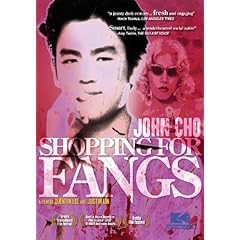
Buy | Rent (Updated version is for purchase only right now)

There's a new, updated version of Shopping for Fangs (SFF) coming out next week, with DVD commentary. That's partially prompts a review that should have appeared about 11 years ago...

I first saw Shopping for Fangs when it was part of the "Class of '97" quartet which debuted at the SFIAAFF in 1997. It was the debut feature for both Quentin Lee (Ethan Mao, The People I've Slept With) and Justin Lin (Fast and Furious, Finishing the Game).

It was also, of the four Class of '97 films, the most deliberately off-beat, with the two main characters dealing with lycanthropy and amnesia (respectively), interspersed with Mexican stand-offs, bible study jokes, touch football, Ranch 99 shopping malls and some good wigs. It also stars a young John Cho in his first major role, playing a lovelorn 20-something who spends a lot of quality time in a Taiwanese cafe. (You'll also spot Lela Lee, aka "Angry Little Girl" playing the sister of Radmar Jao's character, Phil).

If I have one, outstanding impression of SFF, it's how it takes one of the most common of Asian American film themes - identity - and cleverly riffs on it but without ever coming back to hang-wringing about race/ethnicity. Indeed, there's very little "sociological content" in SFF which, especially in 1997, was fairly striking (Sunsets was another example of this). Especially given Justin Lin's later films, in particular Better Luck Tomorrow, you could already see the ways in which he and Quentin really set out to make a very different kind of AA narrative, one that deliberately stepped around the traditions of the past. Parents don't exist. With one key exception, family/immigrant history doesn't exist. Instead, as convoluted as the dual plots were (and I don't mean that in a critical way; the storylines were meant to be deliberately outrageous) SFF was intensely character driven.

By way of summation, there's basically three parallel storylines: Phil, who thinks he might be turning into a werewolf; Katherine, who is having amnesiac blackouts and is married to an emotionally crippled a--hole; Clarance, who is getting over a broken heart and has befriended the enigmatic, Brigette Lin-inspired Trinh. There are bits of interweaving that happens, some small, and the major one is with Trinh, who ends up crossing into Katherine's life when she discovers her purse and phone. (The film is very post-Pulp Fiction though still linear).

All three plots are driven by journeys of discovery but each is fraught with danger. Phil wants to be more assertive (and masculine) but he fears that as a possible lycanthrope, he may be unleashing too much of his inner desire. Katherine is trying to figure out what's happening during her blackouts and why she's being contacted by Trinh.. Clarence wants to quit moping and open his heart again but he's worried about being hurt again.

In trying to think of how to properly this film formally, the two thoughts that keep coming to mind are that, 1) it's laudably ambitious but 2) the sum is less than its parts. The latter is hardly something unique in cinema - one could say that most films that aren't perfect are less than the sum of their parts, but in my mind, SFF just has a lot of parts going on that don't quite gel in the way they aspire to. Having just caught the last half of the film at the ID Film Festival this past weekend, what really resonated was that this was a good, smart script in terms of all it was trying to do but where it ends up more listless is in the execution.

To be sure, some parts are done great (Phil's interest in a co-worker who turns out to be a Bible thumper is deliciously, painfully funny), some of it so-so (much as I'm a fan of John Cho, as Clarence, there just isn't much to invest in), some of it rather flat (Katherine's storyline is woefully underdeveloped, especially her marital relationship). You get where the film wants to take you, especially once you get to the end and its big twist, but the ride's choppy along the way.


I used to screen this film semi-regularly for my students at Cal and they tended to have mixed reactions to it; it was an interesting way to get them to start talking about contemporary AA cinema but I don't think it went over as well as, say, Eat a Bowl of Tea and these days, I'd probably be inclined to show them Better Luck Tomorrow instead. That said, I still think the film is incredibly important for helping mark a particular moment in AA film where you start to see hints of the future already on their way.

BTW, Quentin and Justin both talk about the film for Justin's special "Class of 1997" revisit post on youoffendmeyouoffendmyfamily.com.

Labels: Justin Lin, review

--O.W.

<< Home

RETURN TO THE CLASS OF 97


Damn, I don't know how I slept on this (since it's already three days in) but the ID Film Festival at L.A.'s JANM has been rescreening all the Class of 1997 films.

If you're not familiar with what I'm talking about, start here and then read this great, great post on Justin Lin's Youoffendmeyouoffendmyfamily site which contains testimonials from all the filmmakers involved in that fateful year.

If you're in LA, there's a free roundtable with ALL the filmmakers tonight at 9:30pm, following the closing night screening of Shopping For Fangs.

BTW: I just realized Eric Nakamura has a cool set of posts related to his and Michael Aki's (formerly Idemoto) film, Sunsets.

Labels: film festivals, Justin Lin

--O.W.

<< Home

Monday, July 16, 2007

INTERVIEW: JUSTIN LIN (CINEVUE)


Preface: Seems like I end up interviewing Justin every five years: I did it in 1997, on my then-radio show in Berkeley, I had another set of interviews in 2002, around Better Luck Tomorrow and ACV asked me to interview him for their program for the 2007 N.Y. Int'l Asian American Film Festival.

A lot had changed since our last conversation, to say the least...namely $175,000,000 in global gross for the two studio films Justin had worked on since BLT. Yet, I found him to still be refreshingly down to earth, candid and self-aware (to the point of being a little self-conscious). It's always a pleasure to talk with him about his work as well as the general state of Asian American cinema.

THE INTERVIEW (originally appeared in Asian Cinevision's Cinevue).

My first interview with Justin Lin was in 1997, when he and Quentin Lee were promoting their debut feature film, SHOPPING FOR FANGS. Along with Rea Tajiri (STRAWBERRY FIELDS, HISTORY AND MEMORY), the three chatted about the state of Asian American filmmaking in a cramped studio at KALXFM in Berkeley, CA. At one point I asked if they, as independent filmmakers, would ever consider doing a studio film. Justin replied, half-joking, half-serious: “If I had the chance to make MIGHTY DUCKS 6, I would make the best MIGHTY DUCKS 6 I can.”


When Justin and I sat down in a Silverlake café a decade later, two unlikely things had happened in the intervening years. 1) The Mighty Ducks, now called the Anaheim Ducks, had just won the Stanley Cup a few weeks prior and 2) Justin had indeed directed a sports film for Disney: the boxing flick, ANNAPOLIS, in 2004.


The success of Justin Lin has come as a surprise, not least of all to Justin himself. Since the release of 2003’s BETTER LUCK TOMORROW, he has become the premier Asian American filmmaker, balancing both major studio films (ANNAPOLIS, THE FAST AND THE FURIOUS: TOKYO DRIFT) and independent features, such as this year’s FINISHING THE GAME. Ten years ago, he was still in film school, editing documentaries for the Japanese American National Museum. Five years ago, he was carrying six-figure debt and living off oatmeal dinners. Today, his last three films have collectively made nearly $175,000,000. That dramatic turnaround is how we opened our conversation.


ACV: It occurred to me that it’s been five years since our last interview—not since BETTER LUCK TOMORROW. At the time, doors were starting to open for you and you had certain ideas and ideals about what you wanted to see happen. How close have your vision and your reality coincided?


JL: Having been through film school, you do sit around and you talk a lot. Now that I’ve lived it, I realize...unless you actually get in these (board)rooms, everything is assumption and speculation. I’ve been to enough film festivals and it’s always funny when you talk in speculation like “Oh, would you go do a studio movie?” as if you go to Sundance, everything’s (waiting for you) over there. It’s not, it doesn’t work that way.


ACV: You made BETTER LUCK TOMORROW in 2002, promoted it through 2003, then started ANNAPOLIS in 2004. How dramatic a shift was it going between those two films?


JL: Oh, it was very different because, you know, studio films are market-driven, they’re marketing-driven. You’re talking about (brand)…and my first studio movie was with Disney and you talk about branding…logic doesn’t play in branding, it doesn’t. And these are things that I didn’t understand. I mean, I understood the general idea of what a studio film is, but when you’re fighting branding, that’s a whole other thing… It wasn’t even called ANNAPOLIS when I signed up, it was called THE BRIGADE and it was a boxing movie and somehow the trailer ended up having exploding battleships and stuff.


ACV: You probably didn’t have to make the same compromises with your indie films.


JL: I would say at the end of the day it’s the same thing, two hours of someone’s time projected on screen, but at the same time, it’s completely different, and it’s different agendas of why these films were made. And for me it’s always been trying to find that sweet spot where, in my life I’ve never been creative without worrying about how am I going to pay rent next month, and I wanted to hopefully put myself in a position where I can be creative without thinking “Oh my God, how am I going to…” But it is a totally different way of filmmaking, it’s packaging, and I think as a young filmmaker going into that world, you don’t have a lot of leverage except the fact that you can fight the fight and you try to pick the right situation, the right people, but even then, you’re not going to be perfect.


ACV: Did it feel overwhelming at all?


JL: No, more frustrating at times. Honestly, it was pretty amazing to walk on set that first day and that first day, I remember, was the big “academy scene.” It was like a thousand extras, and you realize (for) lunch, “I’m going to spend the whole budget of BETTER LUCK TOMORROW.” So, it is, in that sense, I was more in awe but having come from the indie world, that’s nothing. I think when you’re somehow trying to trick the police into staying a little longer so you can get your car shots, that’s pressure.


ACV: You had great critical buzz coming out of BETTER LUCK TOMORROW but ANNAPOLIS was more or less savaged by the critics. How was that experience?


JL: When I signed up for it, there was something that really attracted me to it and I wanted to make a Disney kind of sports movie, but... I know as an independent filmmaker, when you come out of nowhere and (critics) support you, they expect you to continue and make this unique voice. But I didn’t want that (expectation) to be my deciding factor. So I knew that going in, and I’ve seen that those films aren’t well reviewed as a whole. But it is hard, you’re a human being and it got personal, at times it did feel like an ambush and I didn’t realize that my name was going to be the thing. When you read reviews about movies like ANNAPOLIS usually they’ll just say “the movie sucks” whatever, but I was amazed at how much of the focus was on me.


I learned a lot about accountability, because at the end of the day … if you hate the movie, I’m accountable. I don’t care if I had to put certain scenes in it …because that was the mandate of the brand, it’s still on me. I don’t work for Disney, I made that movie, I got the title as director, so everything that came and people want to bash me, it’s on me. I will take full accountability. But, I have to say, I feel that some of it was the situation of going from an edgy movie into a studio movie. And (ANNAPOLIS) wasn’t an edgy studio film, it was a very Disney sports movie.


ACV: Maybe this goes back to the MIGHTY DUCKS 6 joke from our 1997 interview but, in saying that you wanted to work on a Disney sports film, what is it about that genre that appealed to you?


JL: I felt like it grabbed me, it was like a fairy tale for guys. It was really about this working class kid who saw something and thought “Oh, if I go across the river, that’s my dream.” So it was actually my most personal movie. Because (with) BETTER LUCK TOMORROW, I was very removed, even the style is very removed in a way, and that was more of an observational piece because I’m not those kids. I didn’t grow up like those kids.


ACV: Let’s briefly talk about THE FAST AND THE FURIOUS: TOKYO DRIFT, a.k.a. FF3. Did that come your way before or after ANNAPOLIS?


JL: Well, I’ll tell you why it came. ANNAPOLIS was getting all this buzz before it came out. When we finished it, the buzz was really hot. I was shooting in London and (Universal) tracked me down, and I turned (FF3) down, I didn’t want to do it because I read the script. Stacy Snider, the head of the studio, said, “You’re rejecting me for a summer movie? Why?” and I felt like it was an opportune time for me to say, “This is exactly how I feel.”


In the original script, first of all, it’s offensive, it’s dated and I had a lot of issues with it and she’s like, “Well, what would you do differently?” and I said, “Well, (in) Japan, you don’t draft temples and Buddhas and girls in kimonos and shit, it’s more post-modern than that.” I had all these ideas, and to her credit, she thought about it, she’s like “Well, then you’re the guy to take us there.” I remember I went home and thought “I don’t know” and then I remember, when I thought about it, it’s funny, you’re talking about hundreds of millions of dollars but this is what tipped it over for me: I thought “Fuck it, I want to create a coolass Asian American male character that ten-year-old Justin would be like, Oh, that’s cool”—and that became the deciding factor for me.


The weekend I finally decided to do it, I was up in Seattle with my (then) girlfriend and she’s laughing at me because she said “Remember when we saw the first FF at the AMC Santa Monica and we both walked out going, “What the fuck, the Asian guys, what the fuck was that?” I was actually teaching a class in Asian American Studies and there were these kids doing a documentary about the rice rockets and I remember I was like, “Wow, that would be an amazing movie. This is a perfect environment to organically put Asian Americans in.” And what happens? They become like the gangsters. So, in a way, it was kind of cool too…in six or seven years’ time, to go back and at least to infuse, however you want to put it…there was an Asian American touch in this third one.


ACV: You’re talking especially about Han, the character played by Sung Kang. He was not in the original script?


JL: No. You can nitpick all you want, but that character has somehow resonated with certain people. We have been going to all these festivals, me, Sung and Roger (Fan). You see businesswomen running up to Sung, hugging him. You see little kids in Barstow, running up to him.


I was in Barcelona in February, I was doing the short for Sundance, and I went to the Picasso Museum and there was this field trip, Spanish junior high kids were walking by, and this kid walked up to me and he (motions like he’s steering a car) and is like “FAST AND THE FURIOUS?” I’m like, how does he know?


ACV: Yeah, it’s not like you’re in the film.


JL: And he couldn’t even speak English and he recognized me in Barcelona, this Spanish kid, not even an American kid, Spanish kid. So that’s the reach of that movie.


ACV: Speaking of issues of race, representation, and Asian America—let’s talk about FINISHING THE GAME. One of the things that I liked most about the film was how self-aware and affectionate it was to the experiences of Asian American actors. At times, it almost felt like a love letter to Asian Americans in Hollywood.


JL: Oh yeah, very much. I feel like that idea has been with me for a while but it felt like it was the right time for it to come out. We had just wrapped FAST AND THE FURIOUS and I just felt like that energy, I had to somehow articulate it. And having come from where we came from, which is very much film school, Asian American Studies and the film festivals, I felt like it was appropriate.


ACV: Did you always want to make this an independent film or did you think about shopping it to studios?


JL: I could have gotten a big budget and it could have been a kung fu movie right now. That’s what they wanted to make it into you know.


ACV: Which, to me, would really miss the point of the film.


JL: Yeah. The set-up is funny enough that they want to make it like KUNG-FU HUSTLE. They keep saying that, they want all these crazy…you can just see them salivating. And for me to pull back, you know as a business (decision), it’s not a good move, but I don’t give a shit.


ACV: This is sort of your first comedy you’ve worked on. I mean there were comedic elements to SHOPPING FOR FANGS but you’ve done three dramas in a row and this is the first comedy. What was it like doing a comedy for a change? A lot of people say it’s easier to write drama than comedy.


JL: Oh, comedy’s tough, because also comedy is very moody in screenings. It’s happened to me where I’ll watch a movie and maybe I’m having a bad day, like NAPOLEON DYNAMITE. I went to the Tastemakers screening at MTV and I remember I saw it and I came out and I was like, “this is fucking stupid.” And I really thought that and then a year later I saw it on TV and I was laughing non-stop. For it to shift–it’s so subjective and it is really tough. Drama, I think with filmmakers, there’s always this joke that if you want to take the easy road then you find something historic then you make the drama and you kill something, you know that’s always been the joke in film school. But with comedy you’re leaving yourself totally naked and that’s why, talk about being scared, that is the hardest thing. The thing that I loved about it is what comedy does come out of drama. There’s a lot we have to say but we don’t even have to openly say it and I feel that I’ve kind of grown with Roger and Sung and everybody now, these are things that we’ve experienced together too so to be able to bring that all, and to work on the subtext and everything, that was definitely a treat. It’s really more of a testament to them because I wanted the movie to have its own life and stylistically this is actually a harder movie to shoot than THE FAST AND THE FURIOUS, design-wise.


ACV: You got to get the 70s hair right…


JL: But even in the camera movements, a lot of times to really get a sense of authenticity or sincerity you don’t want to over cut so the actors have to hit those beats.


ACV: How long have you had this basic idea for the film?


JL: Since I was 12. Remember KTLA, they had the Kung Fu Theatre? That’s how I grew up, but they never shot the real Bruce Lee they had Bruce Li? So I got introduced to Bruce Li and all that. As a kid you’re like “Whoa” with the Flying Guillotine and all that, you’re like “That is awesome.” But then I remember when I first saw ENTER THE DRAGON, that’s when you’re like, “This is another level, who is this guy?” That’s when VCRs were coming out, when I was introduced to it, and you went to CHINESE CONNECTION you watched that like “Wow.” Then you watched GAME OF DEATH and as a kid I was confused. I was like, “Who is this other guy walking around?” because I didn’t understand the concept of a body double.


ACV: But you knew it wasn’t him—that was clear.


JL: Yeah. Then through the years I found out the back stories of it but I was always fascinated by who that guy was and how he got the job. So it has been with me for a while. I even had ideas of making this movie in other forms than a documentary form.


ACV: Why a documentary format? You had said you played around with other kinds of styles of how you could have done it.


JL: I was making all these documentaries at the museum, that’s actually what I did before BETTER LUCK TOMORROW, I was making all these pieces and I was editing Nathan Adolfson’s doc (PASSING THROUGH), so I was editing a lot of docs. I really love documentaries but I realized it wasn’t for me. Documentary is always about using quantity and trying to find those spots and trying to go with those moments and then try to find quality. Narrative is totally different, you’re working differently. I’ve always loved the style of documentary so it was kind of the best of both worlds and also it gives it just enough of the sense of the whole self-reflexive elements to … not wink at the audience but get a sense that this is something that it might be in the seventies but it’s exactly the same. We’re still doing the same shit, nothing has changed.


ACV: I’m curious, and this sort of goes back to what I was saying before about the film being a kind of love letter, not just to contemporary Asian Americans in Hollywood but really historically, too. When George Takei shows up, it’s just genius in that respect.


JL: I remember my parents doing that mom n’ pop fish n’ chips (shop) and so we never had dinner until 10 pm, on school nights even. And I remember on KTLA, 11 pm, Star Trek comes on and you’re like, “Man, this guy’s got to get laid.” You just want to see him get laid, you know? You know Captain Kirk is fucking everyone and even Spock gets action. I think there’s one episode where he almost gets some.


ACV: One of the other films that really came to mind in watching this was Robert Townsend’s HOLLYWOOD SHUFFLE—obviously thematically they’re really similar and also just the time periods. And both films are riffing on 70s films because Townsend’s dialoguiing with a lot of the blaxploitation that came out in the 70s and 80s. Was that much of an inspiration, or an influence, in terms of thinking of how to put yours together?


JL: I saw it so long ago, it might be subconsciously, I can’t totally say no. I remember seeing that, I remember when HOLLYWOOD SHUFFLE came out I was like, “What are short ends?” I wasn’t in film school yet, I didn’t know what that meant but that was a big deal because he had made all the films. It’s always been an inspiration for me as a film maker but I think the 70s there’s something really–I love that period. And obviously this had to take place in the 70s and it gives it that look and that feel and I think it adds a lot more to the discourse.


ACV: What is it about the 70s that you like so much?


JL: For me, it’s interesting, because the 70s for me was in Taiwan so my 70s is always through media and stuff like that. I remember in Taiwan, my family would get together, because Taiwanese TV back then was only three hours a night and I remember we would get together and watch Dance Fever and that’s 70s to me. But having grown up here in the 80s I—I don’t know if it’s true or not—I always romanticize the 70s as that time that almost broke but then it didn’t. It went to the 80s and then the corporations took over and now we’re at this really weird post-modern (stage) where everything is being controlled. So the 70s for me is a sense of real liberation and being able to try anything you want and that’s a personal thing, I don’t know if it’s true or not.


ACV: It sounds like you’re nostalgic about this era that you never actually lived through but you have this idea of what it was like. In fact, more on a technical side, how did you pick the person who was basically responsible for the art direction and the personal styling, as well as the music?


JL: That’s Brian Tyler, he’s awesome. The fact is when you go and make Asian American movies, especially the ones that I want to make, and to have control, you go back to no-budget territory and FINISHING THE GAME is so connected to THE FAST AND THE FURIOUS you wouldn’t believe. Doing a period 70s movie for (our) budget is impossible. But because of my relationships, I was able to get the film for free pretty much, the camera from Panavision because I shoot all my studio movies Panavision so they gave me the camera for free. Universal would literally take me into pre-sets, load them, drive them to our set, leave them for us and we’d make them into our sets. I had guys at Universal calling—prop and wardrobe, getting all that for free. This is a labor of love and these are the connections you have, this is the reality of Asian American films.


One of the things I wanted to make sure of was, I wanted also to provide opportunities in this movie. Here’s what’s so great: I made really good friends with a lot my crew in the studio world to the point where they’re like “I don’t even need to get paid, if you shoot something, call me, I’m there for you” and I appreciate that but at the same time, I felt like this is a journey where we want to give opportunity to people. Like Greg Louie is this young guy who did cutting stuff for us and he’s a great editor. I just feel like, he just needs the opportunity, he has the talent. So instead of hiring other people, I gave the job to him. And Candi Guterres, who’s a very good production designer. Even down to the PAs. We would go to get students and stuff because those were the things that I never had. And to be honest, what fucking pisses me off, and this still happens—a lot of Asian Americans, when they make films, they’ll fucking pay the white crew and they won’t pay (the Asian Americans), they use the community guilt. They’ll pay the Asian American less or no money and they fucking hire white crews and pay them. Fuck that! This is a favored nation all the way across.


ACV: How difficult was it to be able to get that aesthetic down right to be as historically accurate-were those things that really mattered in terms of those things, making sure that the sense of the 70s was communicated as accurately as possible?


JL: Candi did an amazing job. That’s one of the things about that movie was, even if we had no money, I didn’t want the feeling of “Let’s mock the 70s!” If you watch the movie, hopefully, you get a sense of the characters that live in that environment, that exist in that environment. We’re not trying to make it more than it is, even though the 70s was very loud and had certain things. It was a fine balance and on a very shoestring budget she did an unbelievable job, I thought.


ACV: It’s true, especially with the 70s, that line between parody is so easy to cross over because there’s something about the 70s itself that is self-parodic.


JL: And I think that also that would be a disservice to the issues we’re trying to, even if we’re dealing with humor. Ultimately you want to feel like those characters did live in that time or else if you wink at the audience, you lose everything you’re trying to accomplish.


ACV: Now how did you cast for this film? Obviously you used, a lot of the people you’ve worked with in the past show up in there but in terms of everyone else who played a role in that?


JL: We did extensive casting and again, Brad Gilmore is this other young casting director, and really great guy and he found us. And you’re really only as strong as your weakest performance, right, and he did an amazing job of filling everything down to Breeze Loo’s parents and all these little roles.


ACV: Was Dustin Nguyen someone you had in mind for the role that he played? Or is that something that happened during the casting process?


JL: It happened during the pre-production of it. I didn’t know him and I found out later he was always trying to meet up but we just never crossed paths. Again, it was one of those instances and I won’t go into specifics but when I made that decision to go with the best people for the roles, he was the best for that role. And he’s also one of the best human beings I’ve ever met. It’s good to know that you can make friends while working sometimes.


ACV: It’s funny because when I think, or anyone thinks of Dustin Nguyen, at least anyone who knows his history, thinks 21 Jump Street. So when his character has that cop show, was that deliberate or just coincidence that his character and the actor playing him have that history? Sounds like it was a coincidence actually.


JL: In that case it was more of a coincidence. Obviously he was, when I was looking at the names, you’re like “Well, he would be perfect.” At certain points I thought, “Is it too obvious?” But it was far removed enough that I felt that it worked.


ACV: It’s been a while since I’ve seen him in a film. To me he really was the pathos, the heart of it. For a comedy he was the one who had some sort of emotional tragedy.


JL: He got it. I’m so glad that he’s in it.


ACV: We’ve been talking about Sung Kang throughout. Of all the actors, especially those that you worked with on BETTER LUCK TOMORROW, his career has really blossomed the most in terms of he’s gotten the most high profile work since then. A friend of mine recently told me about WAR, that new movie with Jet Li that he plays a role in as well. What drew you to work with Sung to begin with? Did you know him previous to BETTER LUCK TOMORROW?


JL: I didn’t know him. Actually for that role of Han, we were looking and there weren’t that many that had kind of attitude. It’s funny, he came last, at the very end. He came in and I remember I was like “Whoa, this is the guy.” But he had this crazy manager that was like “No! You have to get the lead only because it’s a no-budget movie!” I was like “You want to play Ben?!?” So he actually came in for Ben because his manager was like “You’re not going to get paid, so you got to be the lead!” Which makes no sense. And he did an amazing job as Ben but he was obviously Han.


ACV: This is a whole film about Asian American actors–male actors–out on audition and even though it’s a parody of that process, I imagine a lot of the jokes hit home.


JL: Oh yeah, there’s times on there where it was like, I could feel the pain and it’s almost like therapy for all of us.


ACV: Because they’re sort of playing the role they’re actually forced to do in real life, right? To audition for stuff?


JL: Oh man, if you talk to the actors, it is so funny how before BETTER LUCK TOMORROW, those guys hated each other because they didn’t know each other. All they knew from each other was that they would go into these rooms and they were all there. It took a while, it was awesome to see them all grow and they were like “You know what? We shouldn’t act like enemies, because we should go in there and be who we are.” It was amazing for people to see them grow and to be a part of that. Now, when we travel everywhere, we’re like a family and that means a lot.


ACV: So your films have had very interesting, very compelling Asian male characters. If I may say, I don’t think that same can be said for the female characters that you have done, and I’m wondering, do you find it harder to write female characters?


JL: Look, you’re driven by ideas and this is also a town that when you’re good at doing something, they don’t want you to do anything else. Believe me I’ve actually been looking, and it’s hard to get into these rooms to do movies with lead female characters because after BETTER LUCK TOMORROW I was like the ‘male’ guy. I would also go talk and people would accuse me of “Why didn’t you have Asian American females?” and I’d be like, “Well that movie is not about Asian American females, what do you want me to do?” That movie is a very specific Asian American male perspective. I can only try and serve the idea. I have a couple projects and I feel like it’s going to be up to me, if I feel like I’m compelled enough I’m going to have to go indie again to prove that I can make a movie with female characters.


ACV: Is that what you want to do, that sort of female-centric?


JL: Of course. But if you look at Hollywood as a whole, there’s not a lot of female movies. So I feel like I get it, hopefully we can have this conversation 5 or 10 years from now and my works will show it. Because I’m only as good as the body of work.


ACV: Speaking of which, the obvious comparison to your balance of studio films and independent films would be Wayne Wang. Have you interacted with him much?


JL: I actually got a call from Wayne Wang a few months ago and he’s like, “Let’s have dinner,” so I flew up to San Francisco and we had dinner and we just talked but it struck me and I actually got kind of emotional. We weren’t talking about the film business but he’s the only other guy who can understand a little of what we go through. [?]


ACV: I’m really curious because I was actually going to ask you later on in terms of using Wayne Wang as this model of comparison, but what did you guys talk about during that conversation?


JL: It wasn’t really about any—because he had wanted to do an indie no-budget and I’m always up for it so we were just going to hang out it wasn’t really anything concrete or anything. It was an amazing call because I watched his stuff when I was in film school and when I was in college and to be able to just hang out. We went to this hole-in-the-wall and had Chinese food. It was nothing really verbal but you just got the sense that when we talked about oh, studio this and that there are a lot of things unsaid and you just get it.


ACV: I want to close with bringing this back not just to FINISHING THE GAME but the same conversation we’ve had the last two times we’ve talked, in the different eras. I think your film comes out of a really interesting time in American history. Let’s just start by talking about Bruce Lee, you said at other interviews, you said at the CAAM Festival that growing up he was kind of this double-edged sword because on the one hand his presence and his physicality crushed some stereotypes but also created this whole other set of stereotypes so there’s this whole duality that you’re stuck with. Not to make too bad of a pun here but I think of the battle in the hall of mirrors when you smash one mirror but you still have another fourteen that you’re framed in. In the end do you see him as more of a positive source or does it end up balancing, a sort of wash, what he contributed in that sense?


JL: I think it’s totally positive. As long as he was doing what he loved and he was passionate. If you want to be Long Duc Dong, go be the best Long Duc Dong. There’s going to be consequences, obviously, to what you do but it also should drive me if I have a problem with that then I should go and create other representation in the media. Ultimately it’s not about censorship, it’s not about let’s not do this, let’s do this; it’s about being free to do whatever we want, and then people can judge. I think that’s so important. Obviously I have personal feelings when I see someone doing some buck-toothed joke and I’m like, that’s fucking bullshit, but at the same time if that person is Asian American and they really want to do it I actually want to support them fully as an artist. Because if I have a problem with that then I should go and create something. It’s like the Han (character) in THE FAST AND THE FURIOUS, personally, that means a lot to me. We all have different values and systems but I think ultimately it’s about quantity, if we can have all these different points of view, perspectives, if all these filmmakers can go out and make movies—cause what’s our cinema right now? It’s still in its infancy, there’s not that much point of view. Ultimately I just want to support everybody. Whatever you want to do, go fucking do it. That’s the idea.


ACV: The Asian American film community has grown insanely much bigger than ten years ago when it was amazing to have four films, now we have sixteen and no one blinks an eye. Do you still pay a lot of attention to a lot of other Asian American films? You do the festival circuit: do you get a lot of opportunity to see them?


JL: I try to, it’s hard.


ACV: It’s hard, there is a lot to see.


JL: There’s a lot. I hate to say this but ultimately it’s going to come down to branding. When we did BETTER LUCK TOMORROW, the grassroots campaign, it’s such a mouthful when we’re saying, “Look, it’s not about supporting this movie because you’re Asian and we’re Asian, it’s about taking that five minutes to look at the trailer, look at the reviews and judge it.” Right away people think you’re telling me to support it because you’re Asian and that gets so cluttered. I think it becomes the boy who cried wolf syndrome. No one likes to be like, “I’m supposed to support you because we look the same?” It has to come down to some sort of quality control.


Still, it’s an exciting time now. Sometimes when you get too close, when you get in these rooms and you really learn how the business is done, you see how sometimes the discourse out there is kind of off. Because everybody has that agenda. I guess just as an Asian American film viewer I just want to see more stuff like (Richard Wong’s) COLMA: THE MUSICAL.


ACV: I was reading the O.C. Register and saw that you were able to retire your parents. I’m very curious, when you first expressed an interest in going into filmmaking were they supportive of that?


JL: Yeah. I mean I wanted to go the NBA so….


ACV: They’re like “Any alternative…”


JL: They’re fucking crazy and goofy. I love them because whatever I wanted to do, they never said no. They’ve always said go for it as long as you work hard and love what you do. And that’s something that they instilled in me. I really appreciate that. That’s a crazy thing to say, “I want to go to film school”--I didn’t even know what that meant. It’s good to be able, after twenty-six years, to shut them down, take care of them. Say whatever you want about FAST AND THE FURIOUS, I was able to retire (them) before I was thirty-five. They worked every day, except for Thanksgiving, for twenty-six years.


ACV: What’s the horizon?


JL: Because of the independent stuff I’m doing I have to somehow pay the bills. Somehow I started doing commercials and now I’ve become the car guy, it’s the funniest thing. These last two weeks, like, Cadillac is launching the new CTS and they want me to do the whole campaign, Honda is doing the Accord they want me to do—and I just find it funny because I’m not into cars at all.


ACV: I got to ask this because we’re in L.A. and you’re doing two car commercials: what do you drive?


JL: Oh, I have a (Infiniti) G35. I sold my truck, my Ford Ranger, to finish BETTER LUCK TOMORROW. I was so lucky because Quentin, who’s such a good friend, gave me his old Honda to drive ‘cause I had no car. Finally when I was able to almost get out of debt I was like man, I grew up driving Pontiacs and crap cars, Buicks, so Roger Fan was like, “You got to!” And so I got the G35 and it’s so awesome because when you do THE FAST AND THE FURIOUS…they totally pimped out my ride, I have these rims, they look pretty cool. I didn’t know how cool they were but when I go to a gas station kids will be like staring at my rims.


Labels: interview, Justin Lin

--O.W.

<< Home

Thursday, March 1, 2007

FEATURE: THE CLASS OF 1997


Preface: I wrote this essay for the 2007 SFIAFF Program. I was very thankful and honored that CAAM allowed me to write it...I was a little late in sending them the idea but as it turned out, they had planned to write something about the 10 year anniversary of the famed Class of '97.

The essay itself lays out what made that year so significant but to add a personal note that doesn't appear there: 1997 wasn't my first SFIAAFF but it came during the same semester I took the Asian American Film/Video course at UC Berkeley (taught by Spencer Nakasako) and it was one of the first years that I practically lived at the Kabuki during that week (or so it felt).

It was, to be sure, an amazing time to be witness to what was happening within Asian American cinema and as cliche as it sounds, that sense of change was in the air everywhere you went during that week. In hindsight, it doesn't seem any less momentous - '97 was a crucial watershed. The fact that it came 15 years after Chan Is Missing is a coincidence but a significant one at that especially since the next important year would be five years later, in 2002, when Better Luck Tomorrow and Charlotte Sometimes screened (amongst others).

THE FEATURE (originally appeared in the 2007 SFIAFF Catalog).


Class of 1997: 10 Years Later

Six filmmakers, four narrative features, one year. The Class of 1997 comprised Quentin Lee and Justin Lin’s SHOPPING FOR FANGS, Rea Tajiri’s STRAWBERRY FIELDS, Michael Idemoto and Eric Nakamura’s SUNSETS and Chris Chan Lee’s YELLOW. The arrival of this quartet in time for the ’97 SFIAAFF may have just been coincidence, but looking at the long-term evolution of Asian American independent filmmaking, it’s as if a critical mass had been waiting to coalesce.

The mid-’90s were a transitional time for Asian American narrative cinema. The most influential director of the ‘80s, Wayne Wang, had moved away from Asian American themes following 1993’s JOY LUCK CLUB. There were several new filmmakers filling in the gap, notably Canada’s Mina Shum (DOUBLE HAPPINESS, 1994) and the late Kayo Hatta (PICTURE BRIDE, 1995) but much of the Class of 1997 was comprised of an even younger, emergent generation. Lee, Lin and Lee all came almost directly out of major film schools. Cousins Idemoto and Nakamura were amateur, first-time filmmakers. Even the cohort’s “senior” member, acclaimed experimental/documentary director Tajiri, was still in her thirties.

More importantly, their films suggested that Asian American cinema was at a key thematic crossroads. Though STRAWBERRY FIELDS and YELLOW ostensibly dealt with familiar topics around the traumas of the past and family tensions of the present, they were a leap forward in artistic style and storytelling. Likewise, though SHOPPING FOR FANGS was a film about identity starring an all-Asian American cast, race and ethnicity were barely present in favor of more humorous and existential explorations of self. Following a trio of youth whiling away their summer, SUNSETS had virtually no Asian American themes whatsoever, but its depictions of suburban/rural ennui had a more universal appeal. Collectively, the four films marked a moment where the older traditions of Asian American filmmaking were being shed to make room for new, exciting and imaginative ideas, styles and stories.

Symbolic import aside, the 1997 SFIAAFF also helped plant the seeds for future groundbreaking projects. It was at this Festival where Justin Lin first met YELLOW star Jason Tobin, whom he later cast in a scene-stealing role for BETTER LUCK TOMORROW (2002). Likewise, aspiring filmmaker Eric Byler and writer Jeff Liu met actress Jacqueline Kim at the Festival and the three drove back to Los Angeles, brainstorming what would eventually become Byler’s debut, CHARLOTTE SOMETIMES (2002), a film that also starred SUNSETS’ Michael Idemoto. The Festival also saw John Cho star in both YELLOW and SHOPPING FOR FANGS; he’s since become one of the most prolific Asian American actors in Hollywood.

Perhaps the most telling evidence of how the Class of ’97 signaled a momentous change is how unextraordinary it’s become for the SFIAAFF to host any number of Asian American narrative features (this year boasts 12 in competition). Over the last decade, there’s been a blossoming of dozens of up-and-coming directors including Alice Wu (SAVING FACE), Tanuj Chopra (PUNCHING AT THE SUN), Ian Gamazon and Neill Dela Llana (CAVITE), and So Yong Kim (IN BETWEEN DAYS). Never before has the Asian American cinescape been so broad or diverse.

Yet despite that expanding scope, the most powerful moments are often the smallest. My favorite memory from the 1997 SFIAAFF came at the back of the theater during the sold-out world premiere of SUNSETS. As the credits began to roll, Idemoto and Nakamura, standing behind the seat rows, hugged one another, yelling “we did it, we did it!” It was a personal moment that went unnoticed by most of the audience still staring forward but in a sense, the two were celebrating for all of us. The labor and challenges of making the if lm were, of course, theirs, but in contributing to such an important, watershed moment, the pride and exhilaration for their accomplishment
was ours as well.

—Oliver Wang

Oliver Wang served on the SFIAAFF Screening Committee from 2000 through 2005. He is
currently a professor of sociology at CSU-Long Beach and cultural critic living in Los Angeles.

WHERE ARE THEY NOW?

• Michel Idemoto both directed and starred in the ensemble feature O.B.I.T.S. (1998) and was the lead in Eric Byler’s CHARLOTTE SOMETIMES (2002).

• Chris Chan Lee has directed television in Asia, and produced several films in the U.S. His second feature, UNDOING (2006), screens in this year’s Festival.

• Quentin Lee runs the production company Margin Films, and directed both DRIFT (2000) and ETHAN MAO (2004).

• Justin Lin has directed BETTER LUCK TOMORROW (2002), ANNAPOLIS (2006), and THE FAST AND THE FURIOUS: TOKYO DRIFT (2006). His latest fi lm, FINISHING THE GAME
(2007), screens on Opening Night at this year’s Festival.

• Eric Nakamura continues to run Giant Robot Magazine as well as its related publishing and retail ventures.

• Rea Tajiri continues to practice and teach filmmaking at schools such as UCLA, NYU, Columbia and CalArts.

PHOTO BY PAMELA GENTILE: FRONT (L–R) JUSTIN LIN, REA TAJIRI, QUENTIN LEE
BACK (L–R) CHRIS CHAN LEE, ERIC NAKAMURA, MICHAEL IDEMOTO

Labels: features, Justin Lin

--O.W.

<< Home

Sunday, September 1, 2002

INTERVIEW: JUSTIN LIN (MOTHER JONES)

Preface: This was the last of my three Better Luck Tomorrow-related interviews with Justin Lin in 2002.

THE INTERVIEW (originally appeared in Mother Jones).

Labels: BLT, interview, Justin Lin

--O.W.

<< Home

Thursday, February 28, 2002

INTERVIEW: JUSTIN LIN (ASIANAVENUE.COM)

Preface: This two-part interview originally was conducted for AsianAvenue.com but has since been "lost" on the site. I'm reprinting it, in full, after the jump. Both were done following the big Sundance debacle but Part 2 was conducted right after MTV Films announced that they were picking up the film for distribution.

THE INTERVIEW.


Buzzworthy: An Interview with Director Justin Lin


Justin Lin went into the famed Sundance Film Festival a relative unknown and came out as one of the most talked about filmmakers there. No less than Roger Ebert – the most recognized film critic in the country, if not the world – has written about him and his new film, Better Luck Tomorrow and Lin has gone from being known mostly just in Asian American circles to potentially becoming the next indie film chosen one.

Lin’s previous film, 1997’s Shopping For Fangs (directed by Quentin Lee) was a critical hit among Asian American film festival patrons, but distribution woes hampered its wider release. For his new Better Luck Tomorrow- a story about a group of well-to-do Asian American students who descend into crime and murder – Lee took a major risk in cleaning out his life savings and maxing out his credit cards – not to mention enlisting the funding aid of (MC) Hammer - to pay for this independent feature.

While at Sundance though, a storm of controversy brewed as some viewers – unhappy at the movie’s dark edge and subject matter, attacked Lin for both misrepresenting Asian Americans as well as encouraging youth violence. To his defense came no less than two of the most visible film critics in the country: the NY Times’ Elvis Mitchell and Roger Ebert – the latter of whom used his January 18th column in the Chicago Sun-Times to write about Lin’s film and the need to support it over politically correct paranoia. AsianAvenue.Com spoke with Justin right after he got back from his whirlwind Sundance adventure.

Oliver Wang: I just have to open this by asking – MC Hammer helped fund the film? How did that come about?

Justin Lin: I ran into him in Vegas and we started talking and got to know each other. It was amazing – it’s almost like he was an angel. I called him, he asked “how much do you need” and boom boom, he wired the money within minutes. He never even signed any paperwork and I’m still trying to get his money back but I can’t get a hold of him. He saved the movie.

O: Getting to Sundance - it sounds like things got out of control. I heard that at two different screenings, people literally got into shouting matches in either attacking or defending Better Luck Tomorrow.

J: It’s amazing, if you were in that room, people were so pumped up. It was amazing having two of the top critics in the country [defend the film]. Usually critics just watch movies but they felt so passionate that they had to stand up and voice their opinions. After the Ebert thing, within five minutes, it was going down Main Street, it was buzzing all over the place. It was definitely a Sundance moment.

O: Did you anticipate this kind of passionate response to your film?

J: The whole point of [the film] was to stir things up a little bit, stay true to the characters and to deal with this issue [of youth violence]. This film should open up questions, should be something that you don’t walk out, five minutes and forget about it. You should think about, hopefully, a day or two and you talk to people about it. It’s all about discourse.

O: As one of the few Asian American directors let in the door – so to say – at Sundance, how did you feel about this swirl of publicity?

J; The great thing we found out is that, you go to Sundance, the Asian American contingent is quite small. But this was pretty much one of the biggest buzz films there and it was incredible. As an Asian American filmmaker, I feel like we kind of crossed a threshold. The first thing out of their mouths wasn’t, “oh this was a great Asian American [film]”. People really related to it, our actors walking down the street, just getting stopped signing autographs, taking pictures. People just went across the color lines. They see it for a couple of minutes and they forget [it’s an Asian Ameican film] and people can relate to it, it has universal appeal.

O: That’s funny you should say “universal appeal” since the movie touches on a taboo subject these days, which is youth violence, made all the more risky in the movie world post-Columbine. What made you want to make a movie about Asian American kids going bad?

J: When we read the paper, all of us, every other week, we see something about youth violence and it’s appalling and disturbing and that’s how I feel when I read it. But at the same time, when you read it, you also get a sense you can relate to their anger and that’s what kind of intrigued me. You read about it but people don’t really talk about it and when they do talk about it, it’s never in inclusive terms - it’s very close to us yet everyone distances themselves from it.

O: From what I understand, part of the problem that some had with the film was that they felt like the images of the Asian American youth were very negative…

J: [interrupts] I don’t think it’s negative at all. As a filmmaker, you try to make the best film, you try to stay true to what you’re trying to do. The problem is that every time you see Asian faces on screen, they’re usually there for an “Asian” reason. It’s usually there because they’re a kung fu master, a doctor, a tourist but they’re always on screen for the reason of being Asian or Asian American. And as a filmmaker I don’t think we should have standards different from other filmmakers. It’s not about being negative or positive, it’s about being true to what you’re trying to do.

O: How did it feel to be criticized for making a film – and I’m quoting from one of your Sundance detractor –that’s “amoral for Asian Americans”?

J: I’m Asian American – f--- man, I’ve done more Asian American projects than anybody. Go back to my short films and documentaries. I’m probably more sensitive to these issues than definitely him – he wasn’t even Asian American!

O: He wasn’t even Asian American?

J: No, he was Caucasian. I can’t speak for all Asian Americans, but the ones who were there…there is a certain level of pride when see characters on screen. These characters, they live in this environment, they don’t have to explain why their teenagers in suburbia – they exist. That’s what the struggle is that we go through as Asian Americans. You exist and you live here but at the same time, but you don’t want to have to explain every little reason why you’re doing this and doing that.


A few days after our initial conversation with Justin Lin, it was leaked to the press that "Better Luck Tomorrow" was picked up by MTV. As reported by the Hollywood trade magazine Variety, "In the first-ever acquisition of an Asian-American film from Sundance, Paramount-based MTV Films has ponied up just under $1 million for North
American distribution rights." AsianAvenue.Com caught up with Justin who was amused that the story leaked but was quick to note that the figures quoted by Variety are inaccurate (because the deal isn’t officially public yet, he couldn’t tell AsianAvenue.Com the exact figures involved). This led into a larger discussion about the challenges of marketing and distributing an Asian American film to a wide, non-ethnic specific audience. Here now, Part 2 of our conversation with Better Luck Tomorrow’s Justin Lin.


Oliver Wang: I know you can’t cite exact figures, but this MTV deal must still be fairly big, no?

Justin Lin: They’re putting a lot of muscle behind this, it’s pretty amazing. It was incredible man, they really loved the film and the buzz was getting so big at Sundance that there were three different companies vying for it and within one hour they decided to [acquire the film]. Plus they already signed me up for my next film. It’s amazing, I [was] worrying about my rent when I left Sundance because I put everything I had into this film.

O: Let me be candid – MTV doesn’t exactly have the best reputation when it comes to cutting edge film, though Election was fairly well received. Are you confident that they’ll have what it takes to get this film out in the way it should be?

J: I have faith in MTV. They were definitely one of the studios that was vying for the film that did not demand a re-cut or even discuss possibly changing the ending. If they’re taking up this film, they’re guaranteeing some investment in this film, I think the worst case scenario is still going to be very positive.

O: Were they at all concerned with how to market a film with an all-Asian American cast?

J: The first meeting we went into, they didn’t even talk about the Asian American demographics and that’s a compliment in itself. I was the one who brought it up – "look, there is a community that is starving for Asian American films" and they were ready to bid for this film without even considering.

O: Were all your potential backers as open?

J: You know, I met with Asian American investors and they’re telling me to change these characters to Caucasians. That definitely surprised me. That’s the struggle of being an Asian American. I can’t totally fault them – they were trying to be good business people and they have their own opinions but at the same, I wish they would have some more faith. That was one of most unpleasant experiences on this whole journey.

O: This film will probably hit the theatres towards the end of the year. Between now and then though, Better Luck Tomorrow will be screening for at least three different Asian American film festivals. You’re now in a position where you wouldn’t necessarily have to do that for publicity’s sake but I suspect the festival circuit is still very important to you.

J: We’re educating Hollywood – they don’t really know the existence of Asian American film festivals and I feel like it’s important that it play at festivals. If you neglect [them] it’s not right. Visual Communications was a big part in being able to help [the film] so I felt like it has to play in the community. The great thing is that we can do that and it can still cross over.

O: Speaking on that, it’s clearly been very difficult for most Asian American films to cross over with the exception of something like Joy Luck Club which Better Luck Tomorrow is clearly nothing alike. When you distributed Shopping For Fangs, it didn’t do as well as anyone would have wanted. Do you think things have changed enough now?

J: I did learn a lot from Shopping for Fangs about distribution. I don’t think things have gotten easier, but at the same time I think there’s been this growth in Asian American cinema. It’s also about the right match and helping the distributors learn that there might be a crossover. But the thing is, it’s up to us to do it. You don’t sit there and wait for the studios to figure it out – you got out there and do it. This is an issue that goes beyond the Asian American community, but I think it’s especially pertinent to the Asian American community.

O: What’s interesting about your film is that your characters are all Asian American, but they don’t spend the film being self-conscious about it in the way that most Asian American films seem forced to be. Shopping for Fangs was much the same way. Why haven’t there been more Asian American films like these where ethnic identity is NOT the sole focus?

J: It is so hard to actually get a film, to raise the money to make a film that a lot of times only certain films of Asian American content get the funding. I also think it’s a maturity with Asian Ameican cinema. I was talking to a filmmaker – he made one of the early Asian American films – and he literally thought they were going to go bankrupt, and if they were going to go do that, they were going to put as many messages as they could into that film. I can’t speak for [all Asian American filmmakers] but when you have the opportunity to speak, you’re eager to get that message across. We’re at a point now where we don’t need to do it because it’s already been very well done. It exists, people know about it. For us, I think it’s time to move on.

Labels: BLT, interview, Justin Lin

--O.W.

<< Home

Wednesday, February 27, 2002

PROFILE: BETTER LUCK TOMORROW

Preface: I produced this piece for KQED's Pacific Time program back before Better Luck Tomorrow screened at the SFIAFF in 2002 but after the whole Sundance debacle. The piece includes interviews with director Justin Lin and actor Roger Fan.

THE PROFILE (originally aired on KQED's Pacific Time).

Labels: BLT, features, interview, Justin Lin

--O.W.

<< Home

About Chasing Chan


Previous Posts

  • A QUICK FYI
  • REVIEW: AU REVOIR TAIPEI
  • REVIEW: DIRTY HANDS: THE ART AND CRIMES OF DAVID CHOE
  • RIP LONI DING
  • THE PITFALLS OF ASIAN AMERICAN INDIE FILM (REMIXED)
  • MY BAY AREA PEOPLES
  • AUSTIN'S AAFF COMING UP SOON!
  • HARIMAYA BRIDGE INTERVIEW
  • SAN DIEGO'S FILM FESTIVAL KICKS OFF THIS WEEK
  • INTERVIEW WITH SFIAAFF'S CHI-HUI YANG

Archives

    03.82 | 03.99 | 07.01 | 02.02 | 09.02 | 02.03 | 03.03 | 04.03 | 05.03 | 10.03 | 03.04 | 07.04 | 03.07 | 07.07 | 08.07 | 01.08 | 03.08 | 04.08 | 05.08 | 07.08 | 02.09 | 03.09 | 05.09 | 07.09 | 08.09 | 09.09 | 10.09 | 11.09 | 03.10 | 05.10 | 03.14 |

Asian American Media Resources

  • Center for Asian American Media (formerly NAATA)
  • Visual Communications
  • Asian Cinevision
  • Asian American Film.com
  • Asian American Film Lab

Film Festivals

  • San Francisco (March)
  • Honolulu (April)
  • Eugene, OR (April)
  • Pittsburgh (May)
  • Los Angeles (May)
  • Chicago (May)
  • New York (July)
  • Dallas (Aug)
  • Washington D.C. (Sep/Oct)
  • San Diego (Oct)
  • Vancouver (Nov)
  • Toronto (Nov)
  • Seattle (Jan)

Filmmakers We Like

  • Eric Byler
  • Gene Cajayon
  • Romeo Candido
  • Curtis Choy
  • Patricio Ginelsa
  • Grace Lee
  • Justin Lin
  • Wes Kim
  • Renee Tajima

Friends

  • Poplicks
  • Angry Asian Man
  • You Offend Me, You Offend My Family
  • Jeff Chang
  • Jeff Yang
  • Reappropriate
  • Asia Pacific Arts
  • Fallout Central
  • Hyphen Magazine

Weblog Commenting by HaloScan.com